What’s the Difference Between Hall Effect Joysticks and Regular Joysticks?
If you’ve been shopping for a gaming controller recently, you’ve probably seen the term “Hall Effect joystick” appearing more often. From console controllers to mobile gaming controllers, manufacturers are increasingly highlighting Hall Effect technology as an alternative to traditional analog sticks.
But what’s the difference between Hall Effect joysticks and regular joysticks—and does it actually matter when you’re playing games?
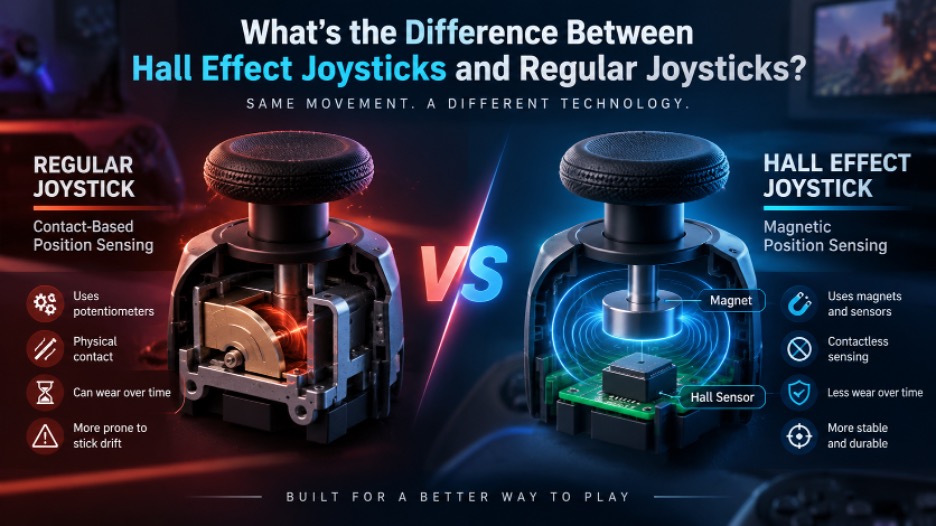
The biggest difference is how the joystick detects movement. Traditional joysticks typically use potentiometers with physical contact points to measure stick position, while Hall Effect joysticks use magnets and sensors to detect movement without relying on the same type of physical contact.
For gamers, that difference can translate into greater resistance to wear-related stick drift, better long-term consistency, and improved durability.
Let’s take a closer look at how the two technologies compare.
How Do Regular Joysticks Work?
Most traditional analog joysticks use components called potentiometers to determine the position of the stick.
When you move the joystick, internal components measure movement along the horizontal and vertical axes. The controller converts those measurements into electrical signals that tell the game which direction you’re pushing and how far you’re moving the stick.
This technology has been used successfully in gaming controllers for decades.
Advantages of Regular Joysticks
Traditional potentiometer-based joysticks still have several benefits:
- Proven technology: They have been used in millions of controllers for many years.
- Lower manufacturing cost: They’re generally less expensive to produce.
- Wide availability: They’re found in controllers across virtually every gaming platform.
- Familiar feel: Most gamers are already accustomed to how traditional analog sticks respond.
The main disadvantage is that the internal contact surfaces can gradually wear down with repeated use.
Over time, that wear can contribute to one of the most familiar controller problems: stick drift.
How Do Hall Effect Joysticks Work?
Hall Effect joysticks take a different approach.
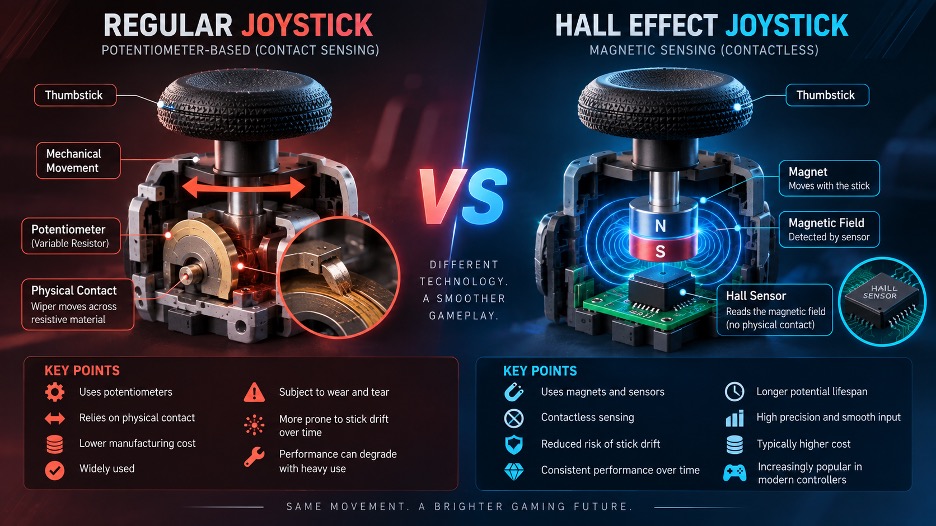
Instead of relying on traditional potentiometer contacts to measure the stick’s position, they use magnets and magnetic sensors. As you move the joystick, the sensor detects changes in the magnetic field and translates those changes into directional input.
Because position sensing doesn’t depend on the same type of sliding electrical contact found in traditional potentiometers, there is significantly less wear on the sensing mechanism itself.
That’s one of the primary reasons Hall Effect technology has become increasingly attractive for gaming controllers.
Advantages of Hall Effect Joysticks
Hall Effect joysticks can offer several important benefits:
- Reduced risk of wear-related stick drift
- Less physical wear in the position-sensing system
- Consistent input over extended use
- Longer potential operating life
- Smooth analog movement
For gamers who use their controllers frequently, these advantages can be especially valuable.
Hall Effect vs. Regular Joysticks: Key Differences
Here’s a quick comparison of the two technologies:
| Feature | Hall Effect Joysticks | Regular Joysticks |
| Sensing Method | Magnetic sensors | Potentiometers |
| Position Detection | Magnetic field | Physical electrical contact |
| Wear on Sensing Components | Very low | Increases over time |
| Resistance to Wear-Related Drift | High | Lower |
| Long-Term Consistency | Generally better | Can decline with wear |
| Manufacturing Cost | Typically higher | Typically lower |
| Common Use | Increasingly common | Widely used |
For most players, the biggest practical difference is long-term durability.
A traditional joystick can perform extremely well when it’s new. Hall Effect technology becomes particularly valuable over time because its sensing mechanism is much less dependent on components rubbing against each other.
What Is Stick Drift?
Stick drift occurs when a controller detects joystick movement even though you’re not moving the stick.
For example, you might release the joystick but notice that:
- Your character slowly walks in one direction
- The camera moves on its own
- Your crosshair gradually shifts
- A racing game detects unwanted steering input

In traditional potentiometer-based joysticks, wear on internal contact surfaces can contribute to inaccurate readings over time. Contamination, calibration issues, and other hardware or software factors can also cause unwanted input.
Hall Effect technology helps address one major cause by removing the traditional potentiometer contact mechanism from position sensing.
However, it’s important to understand that Hall Effect does not mean a controller is physically incapable of ever producing unwanted input. Calibration, firmware, mechanical components, and other factors can still affect controller performance.
A more accurate way to describe the advantage is that Hall Effect joysticks significantly reduce the risk of drift caused by potentiometer wear.
Are Hall Effect Joysticks More Accurate?
Not necessarily in every situation.
A well-designed traditional joystick can be highly accurate, and simply using Hall Effect sensors doesn’t automatically make one controller more precise than every conventional controller.
Joystick performance also depends on factors such as:
- Sensor quality
- Controller firmware
- Calibration
- Dead-zone settings
- Stick tension
- Mechanical design
- Game settings
Where Hall Effect technology has a particularly meaningful advantage is maintaining consistent sensing performance as the controller ages.
Because the sensor doesn’t rely on the same sliding contacts found in potentiometers, normal use produces less wear in the position-detection system.
For someone who plays frequently, that long-term consistency may be more important than a small difference in how two brand-new controllers perform.
Are Hall Effect Joysticks Better for FPS Games?
Hall Effect joysticks can be especially useful for first-person shooters, where small analog movements can affect your aim.
Games such as Call of Duty Mobile require players to make subtle adjustments when tracking enemies, controlling recoil, or lining up long-range shots.
Consistent joystick input can help with:
- Fine aiming adjustments
- Camera movement
- Target tracking
- Recoil control
- Maintaining muscle memory
Hall Effect technology doesn’t automatically make someone a better FPS player, but a controller that maintains consistent stick behavior can provide a more reliable foundation for precise gameplay.
Are Hall Effect Joysticks Better for Racing and Action Games?
The same benefits apply beyond shooters.
In racing games, analog sticks are frequently used for steering, where smooth and predictable input can make it easier to control a vehicle through corners.
Action games and RPGs also rely heavily on analog movement, often during gaming sessions lasting several hours.
Hall Effect joysticks can therefore be particularly appealing to players who:
- Play games frequently
- Keep controllers for several years
- Play competitive games
- Want to minimize the risk of stick drift
- Prefer consistent analog controls over time
Hall Effect Joysticks in Mobile Gaming Controllers
Hall Effect technology isn’t limited to traditional console controllers. It’s increasingly relevant to mobile gaming controllers as smartphones become more capable gaming devices.
Modern mobile controllers can turn a smartphone into a handheld-style gaming system, making analog stick quality particularly important for players using services and platforms such as cloud gaming, remote play, and controller-supported mobile games.
One example is the Serafim S3, a USB-C mobile gaming controller that features Hall Effect joysticks and Hall Effect triggers.
Priced at $89.99 USD, the Serafim S3 combines its Hall Effect controls with a direct USB-C connection for compatible iPhone and Android devices.

Other features include:
- Hall Effect joysticks and triggers
- Direct USB-C connectivity
- Support for USB-C iPhones, including iPhone 15 and later
- Android compatibility
- Interchangeable ergonomic grips
- Passthrough charging
- 3.5mm headphone jack
- Support for phones with cases up to approximately 3mm thick
The S3 also works alongside the Serafim Console platform, which provides features such as game discovery, recording, screenshots, AI Highlights, video editing, streaming, and firmware updates.
This combination makes Hall Effect technology particularly relevant for mobile gamers who want both durable analog controls and a handheld-style gaming experience.
Hall Effect vs. Regular Joysticks: Which Should You Choose?
The right choice ultimately depends on how you play.
Choose Regular Joysticks If:
You play casually, don’t use your controller very often, and want an affordable controller that performs well for everyday gaming.
Traditional analog sticks are still perfectly capable of delivering an excellent gaming experience.
Choose Hall Effect Joysticks If:
You play frequently, care about controller longevity, or are particularly concerned about stick drift.
Hall Effect technology is also worth considering if you regularly play games that depend heavily on precise analog input, including FPS, racing, action, and competitive titles.
For mobile gamers specifically, controllers such as the Serafim S3 ($89.99 USD) combine Hall Effect technology with direct USB-C connectivity, providing an alternative to both traditional mobile controllers and wireless Bluetooth gamepads.
Final Verdict: Are Hall Effect Joysticks Better Than Regular Joysticks?
For many gamers, Hall Effect joysticks offer a meaningful technological advantage over traditional potentiometer-based joysticks—particularly when it comes to long-term durability and resistance to wear-related stick drift.
Regular joysticks aren’t inherently bad. They’re affordable, proven, and can deliver excellent precision when properly designed and calibrated.
Hall Effect joysticks, however, eliminate the traditional potentiometer contact mechanism used for position sensing. That makes them especially attractive to gamers who want their controller’s analog sticks to maintain consistent performance over extended use.
If you’re buying a new controller in 2026 and plan to use it frequently, Hall Effect joysticks are a feature worth looking for.
For mobile gamers, the Serafim S3 at $89.99 USD is one option that combines Hall Effect joysticks and triggers with USB-C connectivity, interchangeable grips, and a mobile-focused gaming ecosystem.
Frequently Asked Questions
Do Hall Effect Joysticks Get Stick Drift?
Hall Effect joysticks significantly reduce the risk of drift caused by the physical wear associated with traditional potentiometers. However, Hall Effect technology doesn’t guarantee that a controller can never experience unwanted input, since calibration, firmware, mechanical components, and other factors can also affect performance.
Are Hall Effect Joysticks Better Than Regular Joysticks?
Hall Effect joysticks generally offer advantages in durability and resistance to wear-related drift. Regular joysticks can still provide excellent performance, especially when new, and are often less expensive.
Do Hall Effect Joysticks Last Longer?
The magnetic position-sensing system doesn’t rely on the same type of sliding electrical contact used by traditional potentiometers, which reduces wear in the sensing mechanism. The overall lifespan of a controller, however, also depends on its other components and build quality.
Are Hall Effect Joysticks Better for FPS Games?
They can be beneficial for FPS games because consistent analog input is important for aiming and camera control. However, overall precision also depends on calibration, dead zones, firmware, stick mechanics, and game settings.
Which Mobile Controller Has Hall Effect Joysticks?
The Serafim S3 is one mobile gaming controller equipped with Hall Effect joysticks and Hall Effect triggers. It connects directly to compatible smartphones through USB-C and is priced at $89.99 USD.